
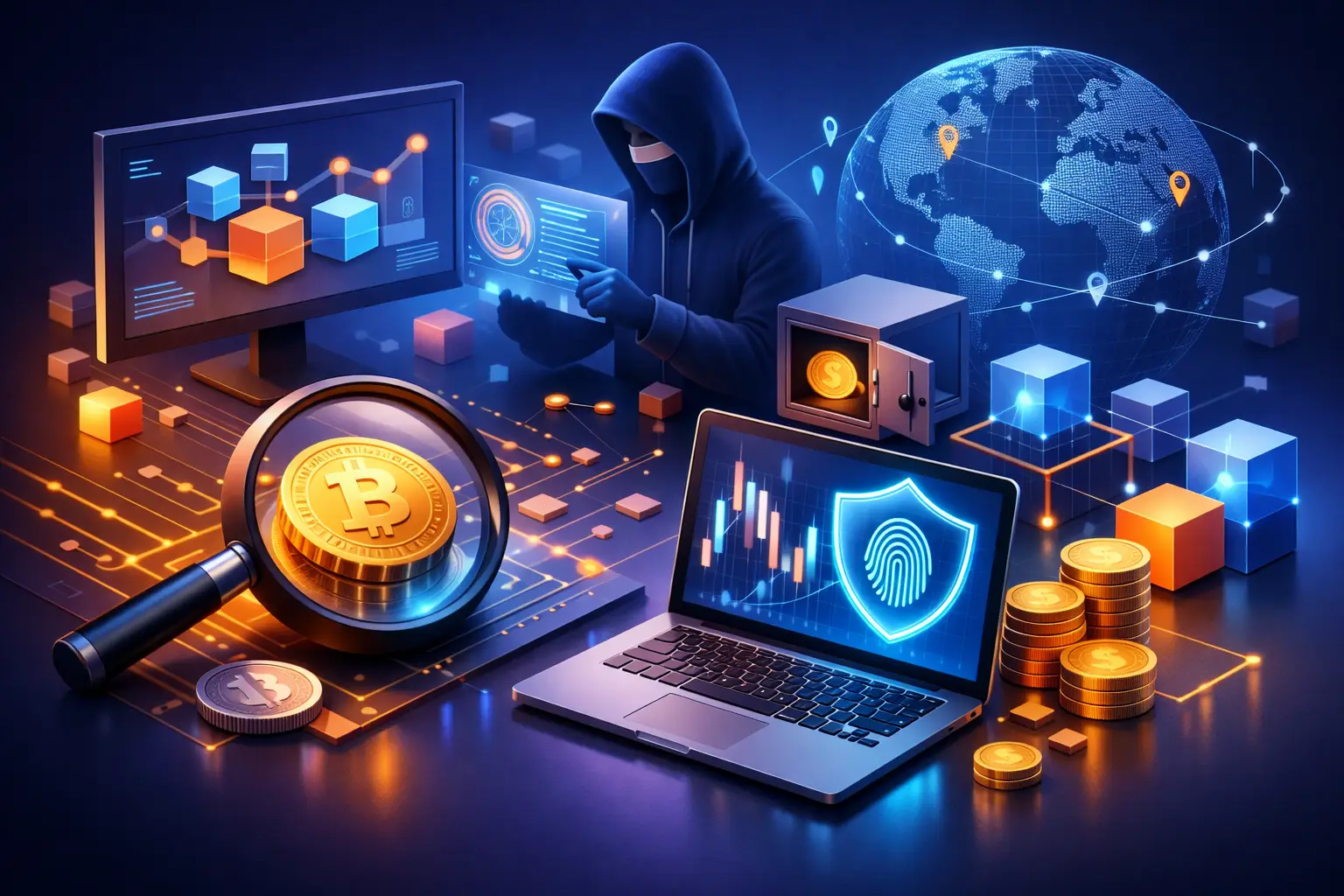
A victim opens a wallet explorer and sees dozens of transfers, unfamiliar addresses, and tokens moving faster than they can document them. That is usually the moment the question becomes urgent: what is crypto forensics, and can it actually help after fraud or theft?
Crypto forensics is the disciplined process of tracing, analyzing, documenting, and interpreting blockchain transactions so they can support recovery efforts, legal action, compliance reviews, or internal investigations. It is not guesswork, and it is not a magic button that reverses a transaction. Proper crypto forensics turns messy wallet activity into an evidence-based record of where assets moved, how the movement occurred, which services were used, and what next steps are realistically available.
What is crypto forensics in practical terms?
In practical terms, crypto forensics combines blockchain analysis with investigative method. The blockchain itself is public on many networks, but public does not mean self-explanatory. Investigators have to identify transaction paths, isolate relevant wallet clusters, distinguish victim funds from unrelated activity, and map interactions with exchanges, bridges, mixers, smart contracts, and other infrastructure.
That work becomes more valuable when it is paired with off-chain evidence. Screenshots, exchange records, wallet logs, device compromise indicators, email headers, chat histories, KYC documents, and police references often help establish the full timeline. A transaction hash alone can show movement. A forensic investigation aims to show context, attribution indicators, and evidentiary relevance.
For a scam victim, this usually answers concrete questions. Did the funds go directly to an exchange? Were they split across many wallets? Was a bridge used to move value to another chain? Is the destination linked to prior fraud patterns? Those details matter because recovery strategy depends on them.
What crypto forensics can and cannot do
Crypto forensics can trace assets across many public blockchains, identify movement patterns, detect laundering behavior, and produce documentation that supports law enforcement referrals, civil litigation, exchange contact, or compliance escalation. In stronger cases, it can help connect stolen funds to a service provider that holds identifying information or controls an account where intervention may still be possible.
It cannot guarantee recovery. That is the most important distinction. Even a well-traced case may face jurisdictional barriers, delayed reporting, weak preservation of evidence, or movement through platforms that are uncooperative or poorly regulated. Some assets are converted quickly, mixed aggressively, or routed through services that reduce visibility. The quality of tracing may still be high, but the enforcement path may be difficult.
This is also where distressed victims are vulnerable to secondary scams. A legitimate forensic firm does not promise certain recovery, does not ask for private keys, does not take custody of funds, and does not invent release fees or clearance charges. Real crypto forensics is evidence-first and process-driven.
How a crypto forensic investigation usually works
A professional investigation starts with intake and preservation. The first objective is to lock down facts before more data disappears or gets overwritten. That includes collecting wallet addresses, transaction hashes, exchange receipts, communications with the suspected fraudster, and any account access records.
From there, investigators build a transaction map. They reconstruct the path of funds from the victim origin point through intermediary wallets and onward to destination services. This often includes identifying peel chains, consolidation wallets, cross-chain swaps, and timing patterns that suggest coordinated laundering behavior.
Address clustering and attribution
Not every address belongs to a different person. One operator may control many addresses, and one service may generate fresh deposit addresses for each user. Crypto forensics uses clustering methods, behavioral analysis, and service attribution to determine which addresses are likely linked and which ones simply interacted.
Attribution is one of the hardest parts of the work. Sometimes an address can be linked to a known exchange, broker, gambling platform, OTC desk, mixer, or scam infrastructure. Sometimes the evidence is only probabilistic and has to be stated carefully. Good forensic work avoids overstating certainty.
Cross-chain tracing and service exposure
Many cases no longer stay on one chain. Funds may move from Bitcoin to Ethereum, from Ethereum to Tron, or through a bridge into another ecosystem. That means investigators need to follow the economic flow, not just the first visible transfer.
Service exposure is especially important. If stolen assets touch a regulated exchange or custodian, there may be a realistic compliance route for escalation. If they move only through decentralized protocols and self-hosted wallets, available options may narrow. Timing matters here because exchange-side records and account states can change quickly.
Why crypto forensics matters in fraud recovery
Victims often assume the blockchain is anonymous and therefore useless for recovery. The opposite is often closer to the truth. Many bad actors rely on the fact that victims do not know how transparent blockchain records can be when examined correctly.
Crypto forensics matters because it creates structure. It turns a confusing event into a documented case file with identifiable transaction pathways, associated services, chronology, and loss calculations. That structure is what law firms, law enforcement agencies, compliance teams, and counterparties need if they are going to act.
It also helps separate viable next steps from false hope. In some matters, the strongest outcome is rapid escalation to an exchange before further off-ramping occurs. In others, the better route is a litigation-support package or a formal fraud report aligned with financial intelligence expectations. Sometimes the key value is not immediate recovery but preserving evidence for later action.
What a forensic report should include
A credible crypto forensic report should do more than list wallet addresses. It should explain the incident background, define the scope of review, identify the source transactions, map the onward movement of funds, and set out the methodology used. It should also clearly distinguish verified findings from analytical inferences.
For legal and compliance use, the report should present transaction evidence in a format that a third party can review and understand. That usually means chronological tables, blockchain references, exposure summaries, wallet diagrams, and narrative interpretation written in plain but precise language. If the report is intended for law enforcement, exchange liaison, or court use, chain of evidence and documentation quality matter.
This is where specialized firms add value. The difference between raw blockchain screenshots and an evidence-grade report is substantial. One shows data. The other presents findings in a form that can support action.
What is crypto forensics used for beyond scams?
Although fraud recovery is a major use case, crypto forensics is broader than scam tracing. Businesses use it for internal investigations, treasury incident reviews, sanctions exposure checks, AML analysis, and dispute resolution. Legal counsel may need tracing to support injunction applications, asset disclosure strategy, or settlement leverage. Insolvency and matrimonial disputes can also involve blockchain tracing where digital assets are relevant.
The same methods apply, but the objective changes. In one case the goal may be recovery. In another it may be proving dissipation of assets, identifying beneficial control indicators, or documenting suspicious transactional behavior for a compliance review.
Limits, trade-offs, and timing
Not every case is equally traceable. Privacy-enhancing tools, rapid token swaps, poor victim recordkeeping, and delayed reporting all increase difficulty. Some networks are easier to analyze than others. Some exchanges are responsive to properly documented requests; others are slow, inconsistent, or outside practical reach.
There is also a trade-off between speed and completeness. Early-stage tracing may be enough to support urgent preservation requests, but a fuller report takes more time. In high-pressure matters, investigators often have to balance immediate escalation against deeper analysis.
That is why case assessment matters. A professional review should tell the client what can likely be established, what remains uncertain, and what procedural path makes sense. AssetTrace, for example, frames this as a formal, non-custodial process centered on evidence, reporting discipline, and coordination with legal or compliance channels where appropriate.
How to tell real crypto forensics from a recovery scam
The distinction is usually clear once you know what to look for. Real investigators ask for transaction records, wallet addresses, and supporting documentation. They explain scope, deliverables, limitations, and probable next steps. They do not ask you to send more crypto to "release" recovered funds, connect your wallet to unverified tools, or disclose private keys.
They also speak carefully about outcomes. A legitimate firm can explain tracing findings, preservation opportunities, exchange exposure, and legal support options. It should not promise that all assets will be returned within a fixed number of days. In this field, certainty is often a warning sign.
If you are evaluating help after a loss, the right question is not simply whether someone can trace the blockchain. The real question is whether they can convert that tracing into usable evidence, credible reporting, and a procedural path that fits your case. That is where crypto forensics stops being a buzzword and starts becoming useful.
¿Ha perdido cripto por una estafa o un robo?
Comience con una revisión gratuita y confidencial. Le diremos con honestidad si un rastreo puede ayudar; la recuperación nunca está garantizada.