
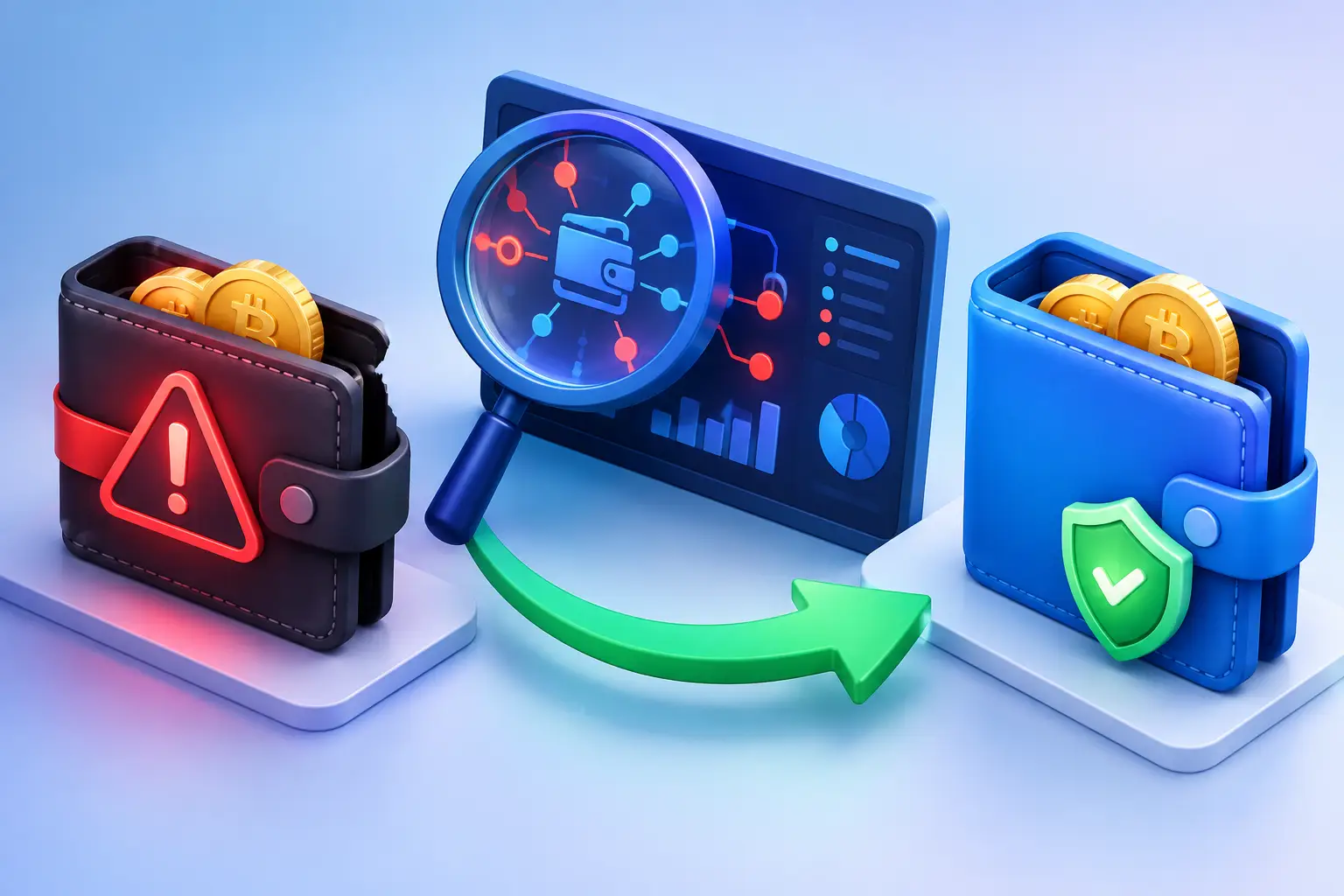
A stolen crypto balance can appear to vanish in minutes. In reality, the transaction trail usually remains visible on the blockchain, even when scammers split funds across dozens of addresses, swap assets, or route proceeds toward an exchange. Scam wallet analysis is the process of turning that visible but fragmented activity into a defensible account of what happened, where the assets moved, and what recovery options may still exist.
That distinction matters. A wallet address is not a name, a location, or proof of ownership by itself. It is one data point in an investigation. Professional analysis connects transaction records with timestamps, token movements, victim evidence, service attribution, and jurisdictional considerations. The objective is not to make speculative accusations. It is to produce a clear evidentiary pathway that can support reporting, legal advice, exchange outreach, and recovery coordination.
What Scam Wallet Analysis Actually Examines
A proper investigation begins with the victim's transaction, not with a search for a convenient answer. The initial task is to establish the source transaction: the sending wallet or exchange account, the destination address, transaction hash, date and time, asset type, network, and amount transferred.
From there, the investigator maps subsequent movements. Funds may be consolidated with other deposits, divided into smaller transfers, bridged to another blockchain, converted through decentralized exchanges, or deposited at a centralized service. Each step should be documented with enough detail for another party to verify it independently.
The analysis also examines behavioral indicators. For example, an address receiving repeated deposits from unrelated victims may be part of a broader fraud collection infrastructure. A pattern of rapid forwarding after each victim payment can indicate an operational wallet rather than an investment account. Repeated interaction with known exchange deposit clusters may identify a potential off-ramp where timely preservation action could be relevant.
These indicators require careful wording. Blockchain analytics can support an attribution assessment, but it does not automatically establish the identity of the person controlling a wallet. Identity information is often held by exchanges, payment providers, telecommunications companies, or other third parties. Access to that information generally requires the appropriate legal or regulatory process.
Why Transaction Tracing Is Not Enough
Many victims can already see that their funds were sent to another address. That is not the same as a forensic trace. A useful case file must explain the sequence of events, preserve source data, distinguish verified facts from analytical findings, and identify limitations.
For instance, a scammer may use a swapping service to exchange USDT for ETH. The asset has changed, but the trace has not necessarily ended. An investigator can analyze the swap transaction, follow the acquired asset, and assess later transfers. If the assets move through a bridge, the work becomes more complex because the trail must be reconciled across source and destination networks. If funds reach a centralized exchange, the focus may shift from technical tracing to evidence preservation, compliance communication, and legal coordination.
The quality of documentation becomes critical at this stage. Screenshots alone are easily challenged because they may omit transaction context, timestamps, network details, or the method used to reach an analytical conclusion. A structured forensic report should preserve transaction identifiers, address relationships, relevant labels, analytical methodology, and a chronological flow of funds.
It should also separate what is known from what is inferred. This protects the victim from overstatement and makes the material more useful to attorneys, law enforcement agencies, exchanges, and compliance teams.
The Evidence Needed Before Analysis Begins
Victims often wait because they are embarrassed, unsure which records matter, or still communicating with the fraudster. Delay can reduce options, particularly where assets may be approaching an identifiable exchange. Preserve the available evidence immediately, even if it appears incomplete.
The most helpful records are the transaction hash or withdrawal confirmation, destination wallet address, exchange account statements, screenshots of the platform or conversation, emails, payment instructions, phone numbers, websites, and dates of contact. For phishing or wallet-draining incidents, retain the malicious website address, approval transaction details, connected wallet history, and any messages requesting a signature or seed phrase.
Do not alter chat logs or rewrite timelines from memory without retaining the originals. Create a separate chronology that states what occurred, when it occurred, what was paid, and who provided the instructions. If multiple transfers were made, record each one separately. A scam operation may use different receiving wallets for deposits, supposed taxes, verification charges, or fake withdrawal fees.
Where possible, export records directly from the exchange or wallet application. Original files and platform-generated confirmations are generally stronger than cropped images. Store copies securely and avoid sending seed phrases, private keys, or complete device backups to anyone offering assistance.
How a Scam Wallet Analysis Supports Recovery
Recovery is not a single action, and no legitimate firm can guarantee a result. The available pathway depends on the asset, blockchain, speed of movement, destination services, amount at issue, available evidence, and the jurisdictions involved.
When tracing identifies funds at or moving toward a regulated exchange, evidence may support a request for internal review, preservation, or account restriction through the appropriate channels. Exchanges will have their own requirements and may only act on requests from law enforcement, legal counsel, or authorized compliance contacts. A well-organized trace helps ensure that the request identifies the relevant transactions and explains the urgency without making unsupported claims.
For counsel, a forensic report can organize the technical facts needed to assess civil remedies, disclosure applications, freezing strategies, or cross-border procedures. For law enforcement, it can reduce the time needed to understand a complex transaction path. For businesses, it can support incident response, internal reporting, insurer communication, and AML escalation.
The outcome may be less direct when funds remain in self-hosted wallets, pass through obfuscating services, or are converted repeatedly across networks. Even then, documenting the trace has value. It preserves an evidentiary record, identifies associated infrastructure, and creates a foundation for action if assets later reach an identifiable service.
Common Mistakes That Weaken a Case
The first mistake is sending additional money after the initial loss. Fraudsters commonly claim that a tax, liquidity charge, gas fee, compliance deposit, or account verification payment will release frozen profits. These demands are frequently part of the same fraud. A genuine blockchain transfer does not require a stranger to collect a private fee before funds can be released.
The second is hiring a so-called recovery agent who requests a seed phrase, private key, remote access to a device, or custody of remaining assets. Those requests create a second risk event. A legitimate forensic provider can analyze public blockchain data and transaction evidence without taking control of a victim's wallet.
The third is relying on a single online wallet-checking tool as final proof. Public tools can be useful for viewing transactions, but labels may be incomplete, outdated, or wrong. More importantly, they do not create an evidence package or determine the appropriate next procedural step.
Finally, victims sometimes contact the suspected exchange with a vague statement that their funds were stolen. This may be understandable under pressure, but it can lead to delays. A concise, documented submission with transaction hashes, a clear chronology, and the correct point of contact is more likely to be actionable.
A Disciplined Forensic Workflow
A professional workflow starts with a case intake and evidence review. This stage confirms the networks involved, identifies the victim transactions, assesses whether a live preservation opportunity may exist, and establishes the scope of work.
The tracing phase follows funds across relevant blockchains and services. Analysts document direct transfers, swaps, bridges, consolidations, and potential exchange exposure. They also assess address clustering and transaction patterns while avoiding claims that cannot be supported by the available data.
The reporting phase converts the analysis into a structured deliverable. Depending on the case, this may include a transaction timeline, flow-of-funds diagrams, wallet and service observations, supporting exhibits, methodology notes, and recommended next actions. AssetTrace applies this evidence-first approach without taking custody of client funds or requesting private keys.
The final operational phase is coordination. That may involve preparing materials for counsel, responding to exchange information requests, supporting a fraud report, or identifying the next realistic decision point. The right action is case-specific. A high-value case with a trace to an exchange may justify urgent legal coordination, while a smaller loss with no identifiable off-ramp may call for preservation and continued monitoring.
Act Carefully, but Act Early
A scammer benefits when a victim feels rushed into paying more money or too overwhelmed to document the first loss. The appropriate response is neither panic nor passive waiting. Preserve the evidence, stop further payments, secure any remaining accounts, and obtain an analysis that distinguishes observable blockchain facts from assumptions.
A clear transaction trail cannot promise recovery. It can, however, replace confusion with documented facts and give victims, counsel, and compliance teams a credible basis for the next decision.
¿Ha perdido cripto por una estafa o un robo?
Comience con una revisión gratuita y confidencial. Le diremos con honestidad si un rastreo puede ayudar; la recuperación nunca está garantizada.