
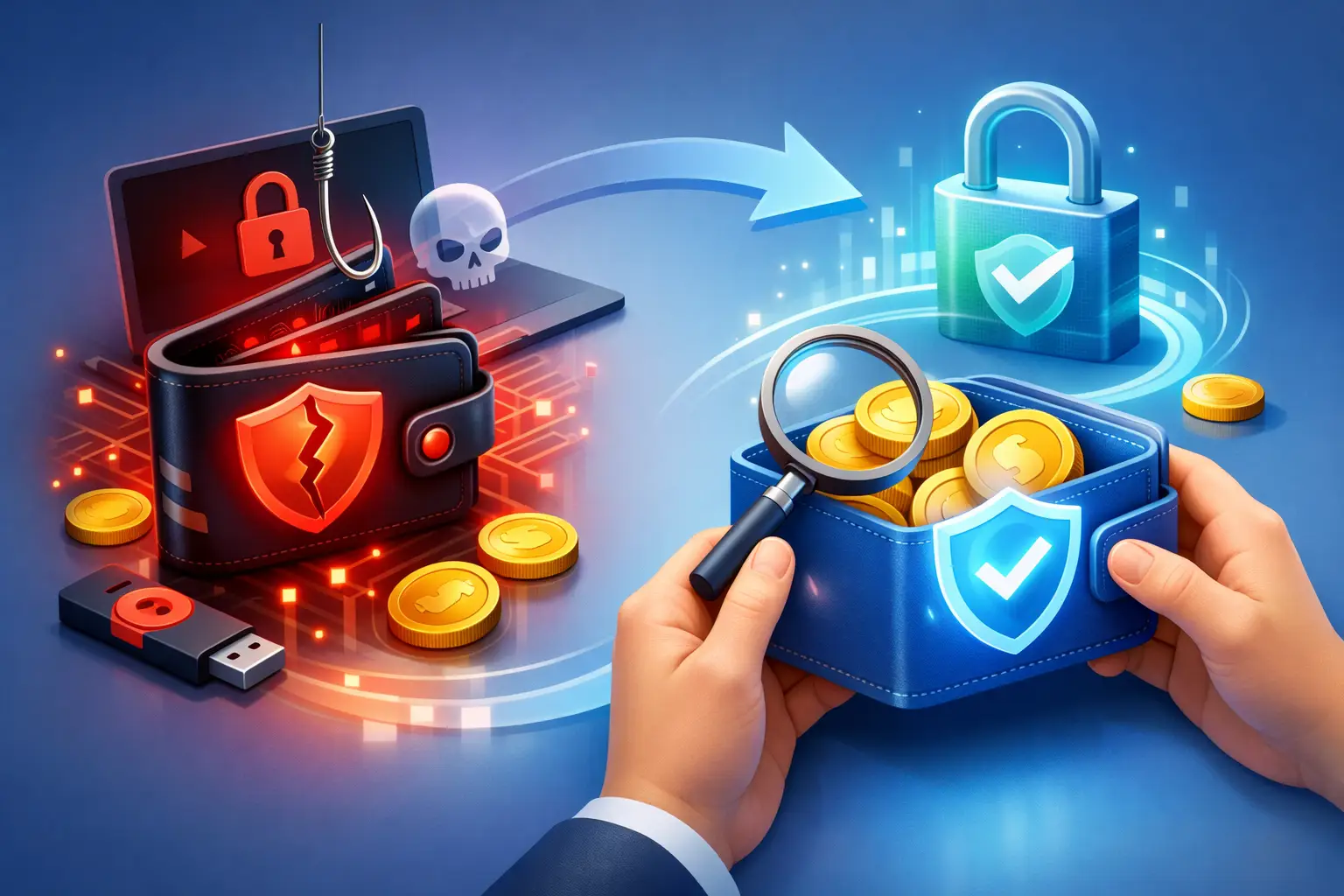
A wallet drain can unfold in seconds, but the decisions made in the first hour may determine whether a recovery path remains available. If you are searching for how to recover hacked wallet funds, begin with one principle: do not erase, reset, or move anything until you have preserved the evidence. A compromised wallet is both a security incident and a potential financial crime investigation.
Recovery is not guaranteed. Blockchain transactions are generally irreversible, and a thief may move assets through multiple addresses, swaps, bridges, or exchanges quickly. Still, fast containment, accurate documentation, and professional transaction tracing can create opportunities to identify an off-ramp, notify a relevant platform, and support law-enforcement or civil action.
How to Recover Hacked Wallet Funds: First Actions
Your first priority is to stop further loss without destroying the transaction record. Disconnect the affected device from the internet if you suspect malware, remote-access software, or browser compromise. Do not continue signing transactions, connecting the wallet to websites, or approving prompts merely to “check” the balance.
Preserve the incident in its original state. Take screenshots of the wallet interface, transaction history, connected sites, token approvals, suspicious messages, emails, and any website involved. Record the wallet address, transaction hashes, date and time with time zone, token types, amounts, and the network used. Screenshots are useful context, but transaction hashes and original account records are more durable evidence.
Create a short incident timeline while details are fresh. Include when you noticed the loss, the last legitimate transaction you made, any links you clicked, applications installed, seed phrase entries, support conversations, and exchange withdrawals. Avoid guessing. Separate confirmed facts from suspicions.
If funds remain in the compromised wallet, move only the remaining assets to a newly created wallet after securing a clean device and confirming that the new wallet has never been exposed. Do not reuse the old seed phrase, password, browser profile, or hardware wallet PIN. For smart-contract wallets, revoke suspicious token approvals where appropriate, but document the approvals and wallet state first.
Determine What Was Actually Compromised
A “hacked wallet” can describe several different events, and the recovery strategy depends on the mechanism. A stolen seed phrase or private key usually means the wallet should be treated as permanently compromised. Changing a password will not repair a wallet whose signing credentials have been exposed.
A malicious token approval is different. In that case, an attacker may have authority to transfer specific assets through a smart contract without possessing the seed phrase. Revoking the approval may stop additional transfers, but it will not reverse assets already sent.
Phishing also takes different forms. A fake wallet extension can capture credentials. A fraudulent support representative may persuade a victim to reveal a recovery phrase. A malicious website can trigger a deceptive signature request. Malware can alter copied addresses, steal browser session tokens, or monitor keystrokes. Identifying the likely attack vector helps establish what must be secured beyond the wallet itself.
For example, if an attacker accessed an exchange account and withdrew funds, the evidence set should include login alerts, account activity, withdrawal confirmations, identity-verification records, and communications with the exchange. If the theft occurred from a self-custody wallet, the investigation will focus more heavily on on-chain movements, approvals, signatures, device exposure, and the source of the compromise.
Secure the Wider Account Environment
Wallet compromise often overlaps with email, phone, cloud-storage, or exchange-account compromise. Secure the accounts that could enable additional theft, starting with the email account associated with financial services. Change passwords from a known-clean device, sign out unknown sessions, review recovery settings, and enable app-based multi-factor authentication where available.
Contact your mobile provider if you observe unexpected loss of service, password-reset alerts, or signs of a SIM-swap attempt. Review bank, exchange, and payment-app activity for unauthorized actions. If you installed remote-access software or suspect malware, do not assume that deleting one application resolves the risk. A qualified device-security review or a full clean rebuild may be necessary before accessing financial accounts again.
Do not share a seed phrase, private key, screen-sharing session, or remote access with anyone claiming they can restore your wallet. Legitimate forensic and recovery providers do not need custody of your assets or your private keys to trace stolen cryptocurrency. A request for either is a serious warning sign.
Trace the Stolen Funds Before They Disappear Further
The next objective is to map the stolen funds accurately. The relevant question is not simply where the first transaction went. Investigators must examine the full transaction path: recipient addresses, subsequent transfers, swaps into other assets, bridges to other networks, interactions with mixers or decentralized protocols, and deposits to identifiable services.
This work requires more than viewing a public block explorer. Evidence-grade tracing connects transaction data to a documented methodology, labels known services where supportable, identifies points of potential intervention, and distinguishes verified attribution from analytical inference. That distinction matters if findings are later presented to an exchange, attorney, insurer, regulator, or court.
Time matters most when traced funds reach a centralized exchange, broker, payment provider, or other identifiable virtual-asset service provider. Those entities may have compliance teams, transaction-monitoring processes, and customer records. A well-supported notification can help place the matter into the correct internal review channel. It cannot compel a freeze by itself, and policies vary by jurisdiction, platform, evidence quality, and the stage of the funds.
Do not publicly confront the suspected thief or send repeated messages to a receiving address. Alerting an attacker can cause faster movement or concealment of funds. Keep communications factual and directed through appropriate reporting, legal, or compliance channels.
Report the Theft With a Complete Evidence Package
File a report with the law-enforcement agency that has jurisdiction over your location and, where relevant, the platform or business involved. A report is more useful when it includes transaction hashes, wallet addresses, a clear timeline, screenshots, the scammer’s contact details, and a description of how the compromise occurred.
If an exchange, bank, or payment provider was involved, submit its fraud report promptly and retain the case reference number. Ask the platform to preserve relevant account and transaction records. Avoid overstating what is known. State that the destination address received the assets and provide the exact on-chain references; do not claim ownership of every later address unless the evidence supports that conclusion.
For significant losses, cross-border matters, commercial disputes, or cases involving a known exchange deposit, a forensic tracing report can provide the structured foundation needed for escalation. AssetTrace works on a non-custodial basis and focuses on documenting transaction pathways, preserving evidence, and coordinating recovery-oriented action without requesting client private keys or taking possession of funds.
Watch for Recovery Scams After the Theft
Victims are frequently targeted a second time by people who monitor public posts, impersonate investigators, or promise guaranteed recovery. The message is often tailored: the operator may cite your transaction hash, claim to have “located” your funds, or insist that a release fee, tax payment, wallet-validation charge, or blockchain synchronization fee is required.
Treat guaranteed outcomes as a red flag. No legitimate investigator can promise that stolen assets will be recovered, particularly when funds have passed through multiple services or jurisdictions. Be cautious of unsolicited direct messages, anonymous social-media accounts, fabricated certificates, and pressure to act immediately.
A credible provider should explain scope, methodology, deliverables, limitations, pricing, and who will handle your data. It should not ask for your recovery phrase, request that you transfer remaining crypto for “safekeeping,” or demand payment to unlock funds supposedly held on-chain. Blockchain does not impose secret release fees on victims.
What Recovery Can Realistically Mean
Recovery may mean different things at different stages. In the best-supported cases, funds are identified at a service that can review, restrict, or preserve them pending lawful process. In other cases, the immediate result may be a forensic report that enables counsel to pursue disclosure, preservation, civil remedies, or coordinated reporting.
Some cases do not produce a practical recovery route. The assets may be rapidly laundered, the off-ramp may be outside an accessible jurisdiction, or available evidence may be insufficient to link activity to an identifiable person or service. That is difficult to hear, but transparent assessment is safer than false hope.
The most useful next step is a disciplined one: preserve what happened, secure what remains, and build a factual record before anyone has the chance to exploit the incident again.
¿Ha perdido cripto por una estafa o un robo?
Comience con una revisión gratuita y confidencial. Le diremos con honestidad si un rastreo puede ayudar; la recuperación nunca está garantizada.