
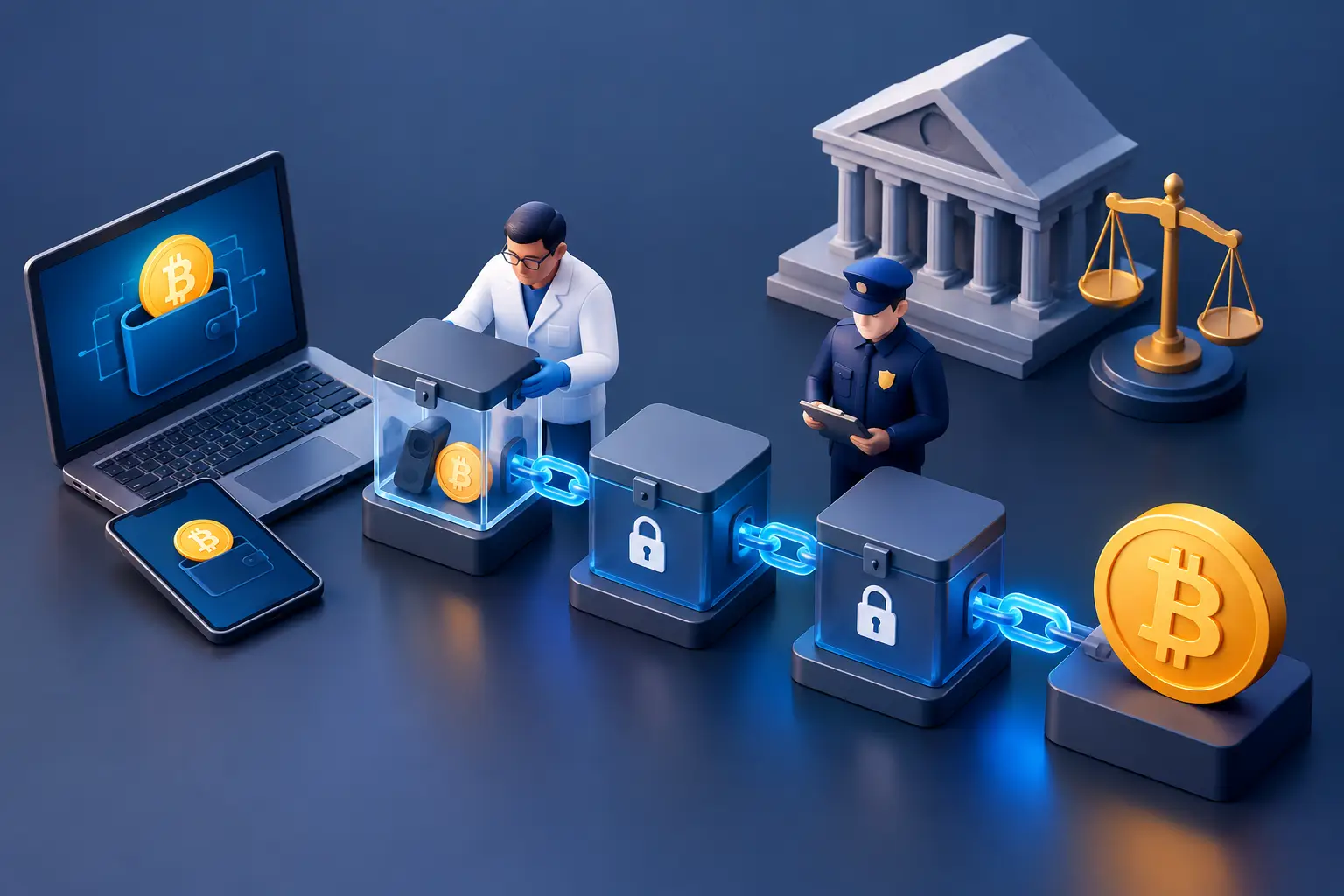
A stolen crypto balance can move through dozens of addresses before a victim has finished filing a report. The blockchain may preserve the transaction history, but an evidence chain of custody determines whether the records used to explain that history can withstand scrutiny by counsel, an exchange, an insurer, law enforcement, or a court.
For crypto fraud victims, this is not paperwork for its own sake. A missing screenshot, an altered export, or an unexplained gap in handling can weaken an otherwise credible claim. The objective is to turn scattered wallet activity, messages, account records, and transaction data into a documented body of evidence with a clear origin, controlled handling, and verifiable integrity.
What an evidence chain of custody means
An evidence chain of custody is the chronological record of who collected an item of evidence, where it came from, how it was preserved, who accessed it, what was done to it, and when it was transferred or reviewed. Its purpose is to show that the material presented later is materially the same as the material obtained at the start of the investigation.
In a conventional financial fraud matter, the evidence may include bank statements, emails, call recordings, and identity documents. In a crypto matter, the evidence set is wider and often more technically sensitive. It can include wallet addresses, transaction IDs, blockchain data extracts, exchange account records, chat logs, phishing websites, token approvals, device artifacts, and screenshots of balances or withdrawal attempts.
A public blockchain does not remove the need for custody controls. Blockchain records are resistant to alteration at the protocol level, but the investigative record surrounding them is not automatically self-proving. Someone must be able to explain how a wallet address was linked to a victim, when the relevant transaction data was collected, what network and block height were observed, and how the analysis was produced.
Why custody breaks crypto recovery efforts
Crypto cases frequently begin in a state of urgency. A victim may clear browser history, reset a phone, delete conversations out of distress, or provide screenshots that have been cropped or forwarded several times. None of these actions proves dishonesty. They can, however, make later verification more difficult.
A weak evidence process creates openings for challenge. An exchange compliance team may need confidence that a reported deposit address and transaction hash relate to a genuine fraud event before it considers preservation or review. Legal counsel needs a reliable factual record when preparing a civil claim, disclosure request, or complaint. Investigators need to distinguish direct evidence from assumptions made during attribution.
The most common issue is not that blockchain evidence is unavailable. It is that the connection between the blockchain and the real-world event has not been documented carefully enough. For example, a transaction may show funds moving into a known exchange deposit address. That does not, by itself, identify the account holder or establish the circumstances under which the victim authorized the transfer.
What should be documented in a crypto case
A defensible evidence file begins with source material rather than conclusions. Each item should receive a unique reference number and a record showing the date and time it was acquired, the person or system that supplied it, its original format, and the method of collection.
For digital files, integrity checks are central. A forensic workflow may create a cryptographic hash value for an original file at intake. If the file is later reviewed or transferred, the hash can be checked again to confirm that its contents have not changed. This is particularly useful for exported chat histories, screen recordings, wallet logs, CSV files, and website captures.
For blockchain records, the case file should normally preserve more than a transaction hash. It should identify the relevant network, wallet addresses, transaction timestamp, block number or height where available, observed value, token contract for token transfers, and the source or method used to obtain the data. If an analyst applies clustering, attribution, or tracing logic, the report should separate observed facts from analytical findings and state any limitations.
A practical evidence register may include the following items:
- the evidence reference number and item description;
- source, collector, and acquisition date and time;
- file format, storage location, and cryptographic hash where applicable;
- every access, copy, analysis, or transfer event; and
- the purpose, recipient, and authorization for each transfer.
The level of detail should match the intended use. A personal incident report may require less formal documentation than a cross-border recovery action, but early discipline preserves options. It is much easier to maintain a clear record from day one than to reconstruct one months later.
Evidence chain of custody from intake to reporting
1. Preserve the original material
Originals should be retained wherever possible. Keep the native email, original message export, unedited image, device record, or account statement alongside any working copies. Avoid annotating the only version of a screenshot or overwriting a downloaded file with a revised name.
Screenshots remain useful, especially when a fraudulent website or chat account may disappear. They should not be treated as the entire evidentiary record when a native export or source URL, account identifier, or transaction detail is available. A screenshot shows what was visible at a moment in time. The underlying record may provide substantially more context.
2. Create controlled working copies
Investigators often need to normalize data, annotate transaction flows, extract relevant pages, or prepare exhibits. These are legitimate working steps, provided the original remains preserved and the derivative material is labeled clearly.
A good file structure distinguishes originals, working copies, analytical outputs, and final deliverables. Access should be limited to personnel with a case-related need. Logs should record material actions, not merely the final report date.
3. Record blockchain observations precisely
Blockchain data changes in a practical sense even when past blocks do not. Wallet balances update, labels evolve, services revise attribution, and a transaction may initially be unconfirmed. An investigator should capture the state of the relevant transaction at the time of review and document the network source used.
This matters when tracing proceeds across bridges, decentralized exchanges, privacy-enhancing services, or multiple chains. The report should state where the trace is direct, where it relies on analytical assessment, and where funds can no longer be followed with confidence. Overstating certainty can damage a case more than stating a limitation plainly.
4. Transfer evidence securely
Sending case files through unsecured email chains or consumer file-sharing accounts can create avoidable privacy and integrity risks. Sensitive material should be transferred through controlled channels, with the recipient, date, purpose, and file integrity recorded.
This is especially relevant when materials move among a victim, legal counsel, forensic analysts, an exchange, and public authorities in different jurisdictions. Privacy obligations may limit what can be shared and with whom. A useful chain of custody protects both the evidence and the people whose personal data appears within it.
5. Produce a report that can be reviewed
A forensic tracing report should allow an informed reader to follow the path from source evidence to findings. It should identify relevant wallet addresses and transactions, explain the tracing methodology, document notable exposures such as exchange deposit addresses, and preserve a schedule of supporting materials.
The report should also avoid promising outcomes it cannot control. A trace to an exchange may create a potential point for legal or compliance action, but it does not guarantee a freeze, disclosure, or recovery. Those outcomes depend on timing, jurisdiction, account status, legal authority, exchange policies, and the quality of the underlying evidence.
What victims should do before sharing evidence
Do not send a private key, seed phrase, or wallet recovery phrase to an investigator, lawyer, exchange representative, or recovery service. Legitimate forensic work can begin with public wallet addresses, transaction IDs, account records, and a structured account of events. Anyone requesting credentials that allow control of your funds presents a serious risk.
Preserve messages and records before blocking or deleting a suspected scammer. Save the relevant URLs, usernames, phone numbers, email headers, wallet addresses, transaction confirmations, and payment instructions. Write a timeline while details are fresh, including what was promised, how contact began, what transfers occurred, and whether any additional fees were demanded.
Avoid paying a supposed release fee, tax, verification payment, or wallet synchronization charge to recover funds. Recovery-room scams frequently exploit victims by claiming that payment is needed to access traced assets. Evidence preservation and blockchain analysis do not require a third party to take custody of a victim's funds.
The difference between a trace and evidence-grade documentation
A basic trace can identify transactions and visually map fund movements. That can be useful for initial assessment. Evidence-grade documentation goes further by preserving source materials, recording analytical steps, maintaining version control, documenting custody, and making the basis for each conclusion reviewable.
The appropriate standard depends on the matter. A small loss with no identifiable service exposure may justify a focused assessment rather than extensive forensic work. A significant loss, a business dispute, an exchange off-ramp, or anticipated litigation may require a more formal process from the outset. AssetTrace applies an evidence-first, non-custodial approach designed to support that transition from chaotic incident data to an actionable case file.
When money has moved quickly, the temptation is to chase every address immediately. Preserve first, document carefully, and act through the right legal and compliance channels. A clear record gives the next professional in the process something they can rely on rather than something they must rebuild.
Lost crypto to a scam or theft?
Start with a free, confidential review. We'll tell you honestly whether a trace can help — recovery is never guaranteed.