
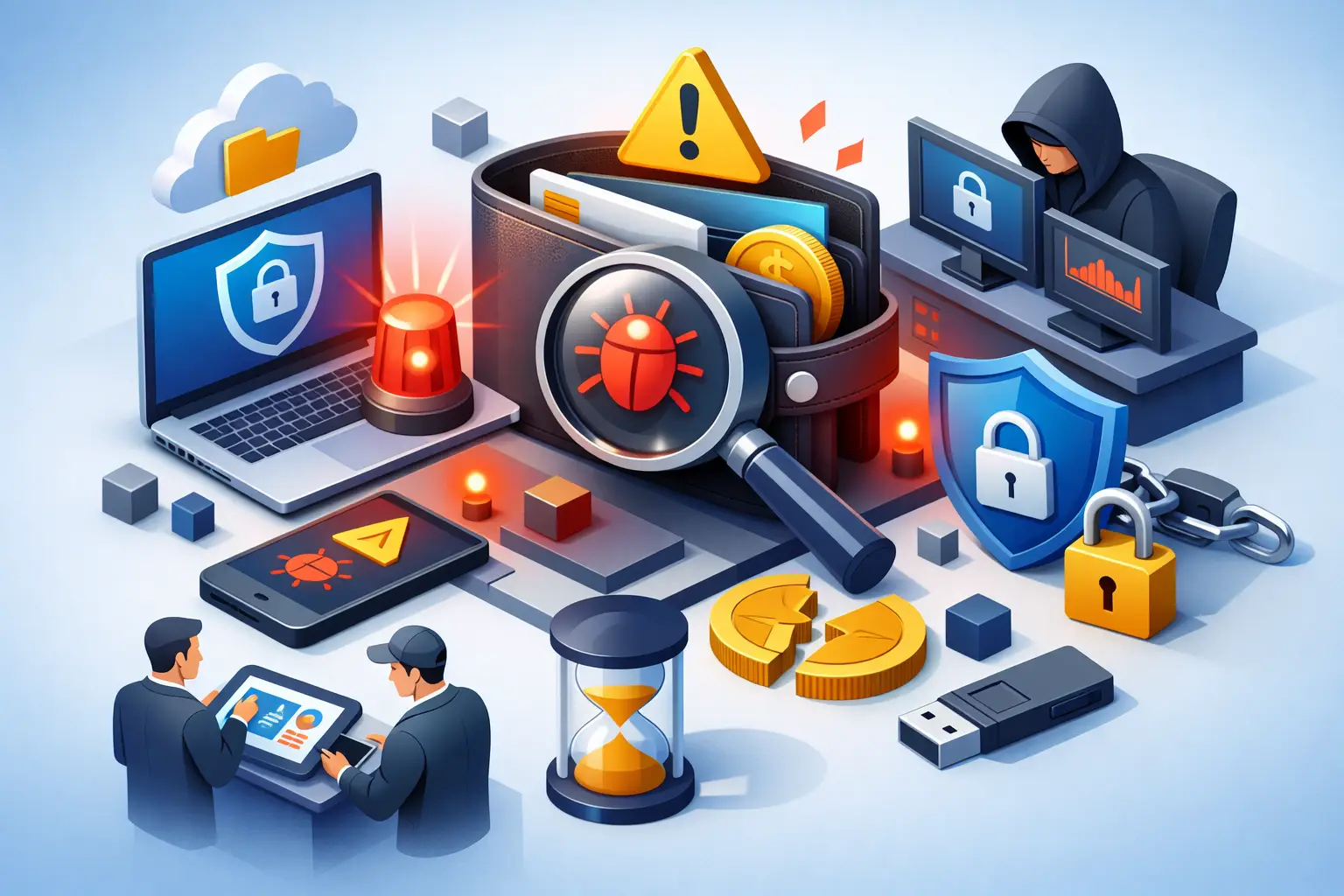
A wallet compromise response guide is most useful when decisions must be made before panic, shame, or a scammer's pressure causes a second loss. A suspicious transaction may be a malicious token approval, a drained software wallet, a leaked seed phrase, or unauthorized access to an exchange account. These situations require different containment measures, but they all begin with the same principle: preserve evidence before attempting to clean up the account.
Do not send funds to a person who claims they can "secure" or "verify" your wallet. Do not share a seed phrase, private key, one-time code, remote-access session, or screen recording. Legitimate investigators, exchanges, law enforcement agencies, and recovery professionals do not need your private keys to trace transactions.
Establish What Was Compromised
The first question is not whether the wallet balance is still visible. It is what an attacker may be able to control. A wallet can remain exposed even after a single suspicious transaction if a seed phrase was entered into a phishing site, copied to an infected device, stored in an exposed cloud account, or disclosed to another person.
If the seed phrase or private key may have been exposed, treat the entire wallet as permanently unsafe. Creating a new wallet on the same device is not sufficient if malware remains present. Use a known-clean device and a new seed phrase generated by a reputable wallet application or hardware wallet. Move any remaining assets only after recording the compromised wallet address, current balances, transaction hashes, and relevant token approvals.
A different situation arises when the seed phrase has not been disclosed, but a connected decentralized application has received an unsafe token approval. In that case, the attacker may be able to transfer a particular token without controlling the wallet itself. Revoking the approval can stop further transfers, but it will not reverse assets already sent. The appropriate response depends on the blockchain, asset type, and the precise permission granted.
For exchange accounts, suspect account takeover when you see unfamiliar logins, changed withdrawal addresses, missing API keys, disabled security settings, or withdrawals you did not authorize. Secure the email account associated with the exchange first. Email access often provides the attacker with the ability to reset exchange credentials and intercept security alerts.
Immediate Containment Actions
Work methodically. Record actions as you take them, including the time, device used, and any platform reference number. This operational record can later help distinguish the original fraud event from steps taken to contain it.
Within the first hours, take the following actions:
- Disconnect the affected device from the internet if you suspect malware, remote access, or a malicious browser extension. Do not erase the device before documenting what occurred.
- Change passwords for the associated email account, exchange account, and password manager from a clean device. End active sessions where the service permits it and enable app-based multi-factor authentication.
- Contact the exchange or custodian through its official support channel if stolen funds have reached, or may reach, its platform. Request an urgent review and possible restriction of the destination account, providing transaction hashes and timestamps.
- Preserve the compromised wallet address and every known destination address exactly as displayed. Copying an address incorrectly can undermine later tracing work.
- Stop communicating with the scammer. Do not negotiate, send a "verification" payment, install software, or follow instructions to bridge, swap, or validate funds.
Do not rush to revoke approvals or transfer residual funds if doing so will overwrite key browser history, wallet prompts, or screenshots that explain the compromise. In a live drain, containment takes priority. In a less immediate event, take several minutes to document the state of the wallet first. The distinction matters.
Preserve Evidence That Can Be Used
Blockchain transactions are public on many networks, but a transaction hash alone rarely explains the full event. Recovery action often depends on connecting on-chain movement with off-chain evidence showing inducement, impersonation, account access, or fraudulent instructions.
Create a contemporaneous evidence file. Save full-screen screenshots of the wallet activity, transaction confirmations, token approvals, balances, phishing pages, messages, emails, advertisements, social-media profiles, and payment instructions. Ensure screenshots show dates, URLs, usernames, and wallet addresses where possible. Save original emails and chat exports rather than relying only on cropped images.
Keep a timeline in plain language. Start with the first contact, advertisement, investment pitch, or suspicious message. Record deposits, wallet connections, requests for seed phrases, failed withdrawals, and the time you discovered the loss. Include the relevant time zone. A clear timeline gives investigators a framework for correlating wallet activity with exchange records, platform logs, and communications.
Avoid altering original files. Store copies in a secure folder and retain the native files, metadata, and device records when available. If you report the matter to an exchange, police department, regulator, or cybercrime portal, save the confirmation number and the exact wording of the report.
Trace the Funds Before They Move Further
Speed matters because stolen cryptocurrency may be swapped, bridged across networks, consolidated with other proceeds, or deposited to an exchange within minutes. That does not mean every case can be frozen or recovered immediately. It means the first trace should identify the transaction path, relevant service providers, and points where legal or compliance action may become possible.
A proper trace examines more than the first destination wallet. It follows asset movements across hops, decentralized exchanges, bridges, mixers where applicable, and identifiable deposit patterns. Investigators may also assess whether destination addresses show links to known fraud infrastructure, scam clusters, or regulated virtual asset service providers.
Victims should be cautious about interpreting a blockchain explorer without context. A transfer to a labeled exchange wallet may create an actionable lead, but it does not prove the exchange holds the funds or knows the account holder. A transfer through a bridge may preserve traceability, but it introduces chain-specific complexity. A professional forensic report should distinguish confirmed facts from analytical inferences and document the methodology used.
For cases involving significant loss, repeat victimization, business funds, or cross-border activity, evidence-grade documentation can support exchange liaison, counsel, insurer notifications, and law enforcement reporting. AssetTrace works on this evidence-first basis: it does not take custody of client assets or request private keys, and its role is to convert complex transaction activity into structured forensic findings.
Reporting and Recovery Coordination
Report the incident promptly to every relevant platform. This may include an exchange, wallet provider, payment service, social platform, domain host, or email provider. Keep reports factual. State the wallet address, transaction hash, asset, amount, date, time, and why the activity was unauthorized. Avoid speculating about an attacker's identity unless you can identify the basis for that conclusion.
Law enforcement reports are also more useful when supported by an organized evidence package rather than a general statement that crypto was stolen. Bring the timeline, transaction list, communications, platform reports, and details of any known exchange exposure. If legal action is contemplated, counsel may need a forensic report that can be explained, reproduced, and used across jurisdictions.
Recovery is not guaranteed. It depends on the speed of reporting, the path of funds, whether assets reach an identifiable service provider, the provider's policies, available legal authority, and the quality of the evidence. Be skeptical of anyone who promises certainty, claims to have already recovered funds without documentation, or demands payment to release a nonexistent balance.
Prevent a Second Compromise
The period after a theft is when many victims are targeted by recovery-room scammers. They may impersonate investigators, government agencies, exchanges, journalists, or prior victims. They often claim to have located the funds and request a tracing fee, tax payment, wallet connection, seed phrase, or remote access before release.
Treat unsolicited recovery contact as a risk indicator. Verify any firm independently, ask what evidence it can produce, and confirm that it will not require control of your wallet. A legitimate process should define scope, deliverables, limitations, data handling, and the distinction between tracing, reporting, legal coordination, and actual asset recovery.
Your next action should be deliberate: secure the remaining assets, preserve the record, and place the evidence in the hands of parties capable of acting on it.
Krypto durch Betrug oder Diebstahl verloren?
Beginnen Sie mit einer kostenlosen, vertraulichen Prüfung. Wir sagen Ihnen ehrlich, ob eine Nachverfolgung helfen kann — eine Rückführung ist nie garantiert.